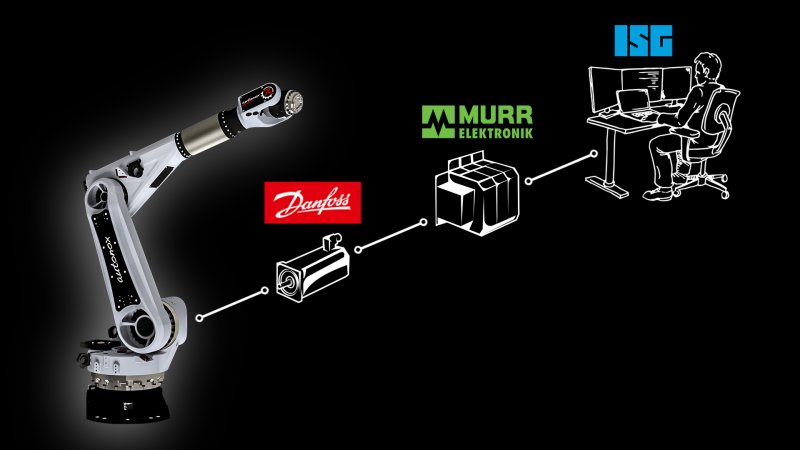
Industrial automation is at a turning point. For a long time, the market was dominated by proprietary systems in which robots were integrated into machine environments as closed units with tightly defined control and drive concepts. Today, a new generation of robotics is emerging, one built from open, seamlessly combinable components that deliver a level of flexibility, integration depth, and future readiness that conventional systems can hardly achieve. The combination of autonox Robotics, Danfoss FlexMotion, Murrelektronik Vario-X, and ISG demonstrates a concept study that not only unites mechanical precision and powerful drive technology, but also consistently incorporates the software and infrastructure layers.
The foundation is provided by the kinematics from autonox Robotics. The company offers robust and highly precise robot mechanics designed to be fully independent of specific control or drive systems and to integrate directly into modern machine architectures as standardized components. With more than 350 different kinematic variants, autonox provides the world’s largest portfolio of robot mechanics, covering all common requirements for payload, dynamics, and installation space. The decisive factor is the open-interface approach: the mechanics can be integrated directly into a machine’s existing control and drive technology, without proprietary barriers or closed system logic. As a result, the robot becomes a neutral, industry-grade component that fits seamlessly into existing or new machine designs.
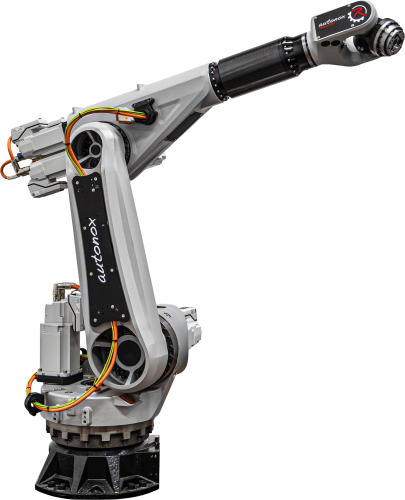
In this solution, a serial six axis mechanism, the articc6-2257-30kg, is used. With three translational and three rotational degrees of freedom, a nominal payload of 30 kg, and a reach of 2257 mm, it is suitable for a wide range of industrial applications. It can be deployed for tasks such as assembly and handling as well as demanding processes like dispensing or welding. The delivery package includes the complete robot mechanics including gear units, a documented multi hour test run as final quality check, and the free installation of the customer supplied drive technology. In addition, autonox provides the necessary adapter technology so the mechanics can be operated with various servo drive systems.
While autonox Robotics provides mechanical precision and openness, Danfoss FlexMotion forms the drive-technology foundation of this architecture. FlexMotion relies on a decentralized structure in which the integrated servo drives (a combination of a PM motor and servo controller in a single housing) are positioned directly on the machine. As a result, the control cabinet is not only significantly reduced in size, but often minimized to the bare essentials. One standout feature is the daisy-chain cabling principle: short, pre-assembled hybrid cables (combining the DC link voltage, supply voltage, STO, and fieldbus lines in a single cable) connect the drives (ISD® 520) mounted on the robot. By reducing the system to just one hybrid cable coming in from the outside, installation and wiring efforts can be greatly reduced, potential error sources are minimized, and maintenance processes become considerably simpler. While this principle is currently demonstrated as a conceptual study for the 6‑axis mechanics used here, it can already be applied to parallel kinematics. At the same time, the system remains open to various industrial communication standards such as Profinet, Powerlink, or EtherCAT, enabling FlexMotion to integrate seamlessly into a wide variety of machine and control architectures. The integrated safety functions ensure that high dynamics and safe motion sequences do not contradict one another but can coexist naturally.
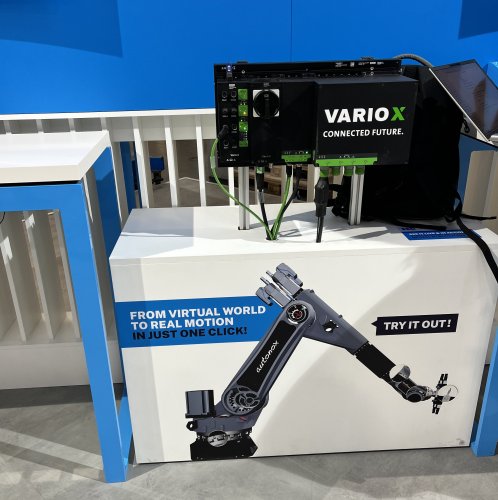
To enable these technologies to reach their full potential, the infrastructure must follow the same principles of openness and decentralization. This is where Murrelektronik’s Vario X platform comes into play. Vario X is a decentralized automation concept in which control, power distribution, I/O, and drive technology are placed directly in the field right where they are physically needed. Automation functions are relocated into the field while still being able to reintegrate with higher-level control environments as required, and can be flexibly expanded, replaced, or updated just like apps on a smartphone. This allows robot mechanics and decentralized drives to be seamlessly integrated into machine control systems without additional cabinets or proprietary boundaries. The plug and play philosophy with pre assembled hybrid cables significantly reduces installation effort, minimizes errors, and decreases the machine’s overall footprint by eliminating traditional control cabinet structures. The ability to replace or expand components during operation gives the architecture high adaptability. At the same time, the structured system layout forms the basis for a digital twin of the installation and automation logic, enabling many steps to be completed before real commissioning begins—this is where ISG’s simulation technology comes into play.
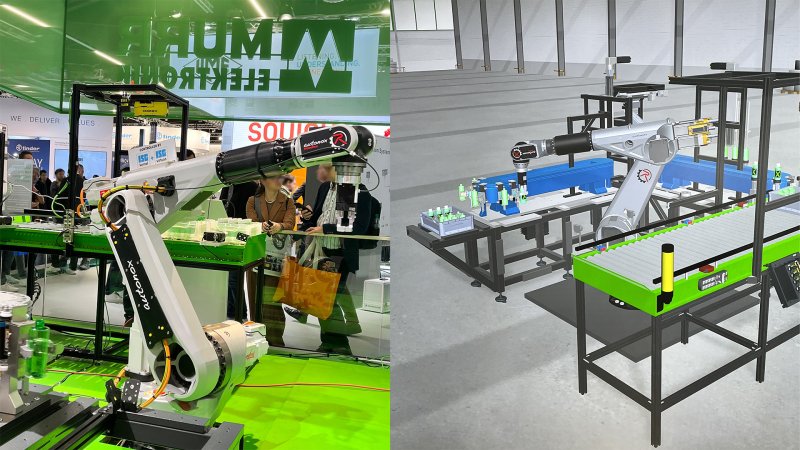
While mechanics and drive technology form the physical foundation, ISG opens the virtual dimension of modern robotics with its software solutions. With ISG virtuos, entire machines and robotic applications can be simulated in detail. Motion sequences and processes can be modeled, tested, and optimized within the digital twin long before the real system performs its first move. This dramatically shortens the time to productive operation, which is a major advantage - especially for complex systems under tight deadlines. The combination of these four components creates an automation and robotics solution that goes far beyond the sum of its parts. The precise, control independent kinematics of autonox Robotics meets the decentralized and safe drive technology of Danfoss FlexMotion. The field-level installation with Murrelektronik Vario X provides an infrastructure that simplifies extensions and supports the continuous maintenance of the digital twin. ISG’s virtual commissioning reduces project timelines and increases process reliability. The result is robotics that is technically robust, economically attractive, and environmentally sustainable. For machine builders and system integrators, this interplay enables direct integration into machine concepts, lower installation and operating costs, and above all the assurance that systems can be flexibly adapted to future requirements without lengthy modifications. The result is a robotics and machine architecture that is not only better but future proof and already shows what tomorrow’s fully decentralized factory can look like.
autonox Robotics GmbH autonox Robotics is a company based in Willstaett, Germany (Baden Wuerttemberg), specializing in control and drive independent robot mechanics since its founding in 2002. The company develops and manufactures its products in-house and offers one of the industry’s most extensive catalogs of standardized kinematics for industrial applications. Key target groups include machine builders and robot integrators that require flexible robot mechanics that can be seamlessly integrated into various automation and control platforms. Neben dem deutschen Hauptsitz betreibt autonox Robotics auch eine Niederlassung in Nordamerika, um internationale Märkte direkt zu unterstützen.
Danfoss Danfoss is a globally active industrial company and one of the technological leaders in drive, energy, and automation technology. The Danfoss Drives division is considered one of the world’s leading manufacturers of frequency converters and motion control solutions, supporting machine building, industry, and energy technology with modular, scalable, and openly integrated system architectures. The company follows a flexible platform strategy that enables the use of various controls, motors, and communication standards. Customers benefit from high integration capability, technical robustness, and decades of industry focused development expertise.
ISG Industrielle Steuerungstechnik GmbH ISG, based in Stuttgart, is a technology company established in 1987 specializing in industrial control, automation, and simulation technology. With over 35 years of experience, ISG supports machine builders and system integrators worldwide in digitalizing their development and commissioning processes. The company has deep expertise in CNC, robotics, and motion control software and develops modular platforms that integrate with diverse control environments. Through close cooperation with industry and research partners, ISG continuously advances digital engineering methods and actively shapes the future of automated production systems with its team of around 70 employees.
Murrelektronik Murrelektronik is an internationally active provider of modern automation and installation technology, specializing in decentralized system architectures. The company develops solutions that reduce installation effort and complexity, increase efficiency and system availability, and support digitalization in mechanical and plant engineering. Murrelektronik is considered a technological leader in modular, scalable installation concepts and focuses on flexible infrastructure systems that can be easily integrated and expanded. With innovative approaches and a global perspective, the company makes a significant contribution to the advancement of forward looking automation solutions.