From robot integration to integrated automation
For machine builders, the real challenge begins where technological possibilities need to be transformed into productive machine concepts. The key question is: How can robotics, engineering and automation be combined to achieve maximum performance, efficiency and cost-effectiveness?
The answer lies where value is created: directly inside the machine.
Particularly in the automated assembly of small components, the overall performance of the machine is crucial to success. Whether sensors, connectors, switches, disposable medical products or electromechanical assemblies, many applications rely on rotary indexing systems with cycle times measured in tenths of a second. Every fraction of a second saved directly increases productivity, output and cost-effectiveness. This is precisely where robotics delivers its greatest added value, not as an external automation module, but as an integral part of the machine.
Mechanics, drive technology, control systems and process logic are coordinated within a consistent engineering approach and intelligently interconnected. This creates highly integrated machine solutions in which all components work together seamlessly. The result is reduced complexity, maximum efficiency and processes consistently designed for maximum productivity.
In small-parts assembly, workpieces pass through various assembly, joining, inspection or handling stations on a rotary indexing table. As each component moves from station to station, a precisely defined operation is performed at every position. This enables short cycle times, compact machine concepts and high output within a minimal footprint
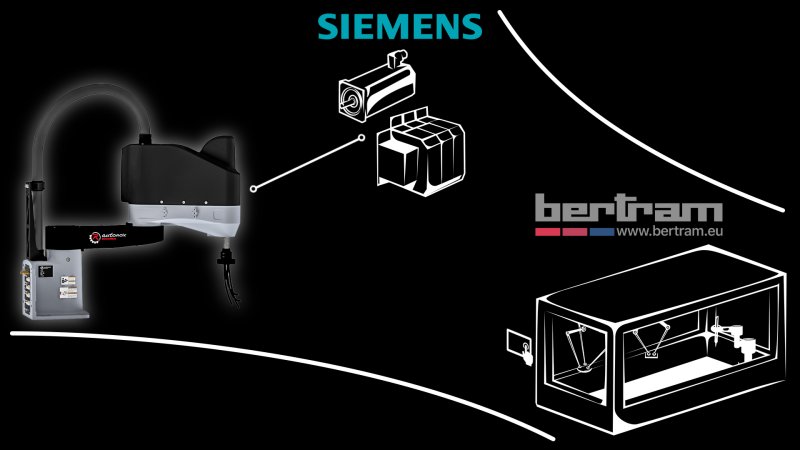
Many of these assembly and handling tasks are traditionally performed using linear systems. While such solutions offer high performance, they often require extensive mechanical coordination of the individual axes. Every movement must be mechanically defined and synchronized and, in the event of product changes, frequently requires mechanical adjustments. As process complexity increases, so does the engineering effort. The use of proprietary robot systems only reduces this effort to a limited extent. Their separate control architectures create additional data interfaces that must be integrated into the machine control system. In addition, direct access to the drive control is often not possible. The exchange of safety signals between the robot controller and the machine controller also creates additional integration effort.
This is where integrating robot mechanics offers significant advantages. Motion sequences are no longer defined by the mechanics, but described in software using the kinematics. A sCara robot, for example, can flexibly execute different positions, orientations and sequences within the same station without requiring additional mechanical axes or modifications. At the same time, the number of components is reduced while the system gains greater flexibility of movement.
Machine-integrated robotics demonstrates its particular strengths in modern assembly systems that need to accommodate product variants, changeovers or future expansions. The robot does not operate as an external automation unit, but becomes a functional part of the rotary indexing system. Programming, diagnostics, operation and service are all handled via the same automation platform as the rest of the machine. This creates clear engineering structures and ensures high system availability in operation.
The robot as a specialized component
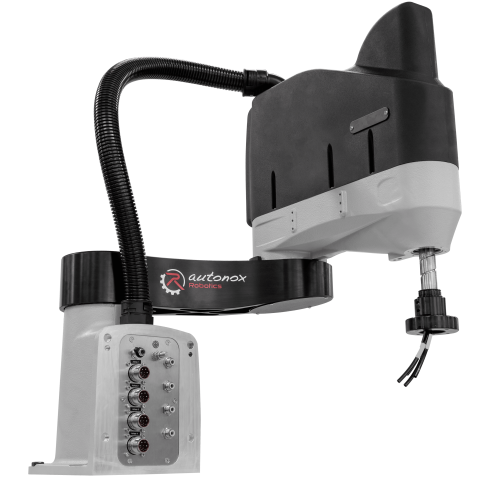
For these applications, Bertram Elektrotechnik GmbH relies on mechanics from autonox Robotics. In addition to DELTA mechanics with 3-, 4- and 5-axis kinematics, the sCara4-800-6kg (AT_00024) sCara mechanics, for example, is used as a compact kinematic solution with an 800 mm reach and a 6 kg payload, specifically designed for dynamic handling and assembly tasks.
The mechanics consistently follows the autonox Robotics component principle. The robot mechanics is supplied independently of the control and drive system and can therefore be optimally adapted to the requirements of the respective machine. This gives machine builders the freedom to seamlessly integrate robotics into their preferred automation architecture.
Siemens as a common platform
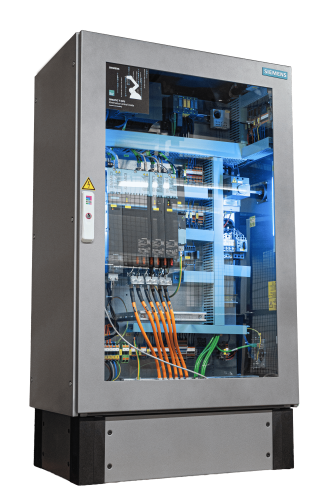
The full potential of this approach is unlocked through integration with the Siemens automation environment. autonox robot mechanics equipped with Siemens servo motors can be fully integrated with SIMATIC Technology CPUs, SINAMICS drive systems and SIMOTICS servo motors. Programming, motion control and robotics are handled within the TIA Portal, making them an integral part of the machine control system.
Motors, drives and robot axes are not treated as a standalone robotic system. Instead, the entire machine uses the same control and motion-control platform. From the machine builder’s perspective, the robot behaves like any other machine axis, enhanced by the required kinematic functions. This reduces interfaces, simplifies engineering and provides maximum transparency across the entire process.
Bertram as an integrator of complex assembly processes
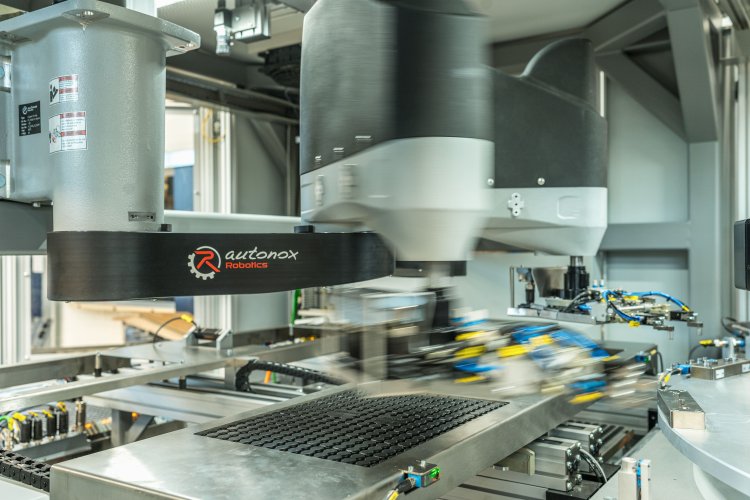
As an autonox LINKED Integrator and Siemens Solution Partner, Bertram specializes in the development of sophisticated automation, assembly and production systems. The combination of mechanical engineering, electrical engineering, machine vision and software development provides the foundation for integrating robotics as an integral part of complex manufacturing processes.
Users benefit particularly from this integrated approach in highly dynamic assembly processes. Robotics, feeding technology, inspection systems and assembly processes are not developed separately, but considered from the outset as a coordinated overall system. The result is compact machine concepts with high performance and clearly defined responsibilities.
The role of the integrator is crucial: only through the intelligent combination of components, software and machine-building expertise can individual technologies become a productive overall solution.
The robot disappears, the performance remains
The combination of autonox sCara mechanics, the Siemens automation platform and Bertram’s integration expertise demonstrates how modern small-parts assembly can be implemented today: one control system, one drive environment, one engineering platform and one intelligently designed, fully integrated machine concept.
In this way, robotics evolves from a separate automation module into what it should be in high-performance rotary indexing systems: a fully integrated component of the machine. Because better robotics starts in the digital world, is built on the right components and delivers its greatest value where everything comes together: inside the machine.
About the partners
Siemens Siemens is a global technology and industrial company headquartered in Munich and Berlin. Founded in 1847 by Werner von Siemens, the company is now one of Europe’s largest technology and engineering companies. Through its automation and digitalization solutions, Siemens supports customers across industry, infrastructure, mobility and healthcare. Its key industrial platforms include SIMATIC, SINAMICS and the Totally Integrated Automation (TIA) Portal, which provide an integrated environment for engineering, motion control and machine automation, enabling efficient integration of hardware and software.
Bertram Elektrotechnik GmbH Bertram Elektrotechnik GmbH is a medium-sized technology company based in Bevern, Lower Saxony. Founded in 1949, the company specializes in the development and implementation of customized automation, assembly and production systems. Bertram combines expertise in mechanical engineering, electrical engineering, machine vision and software development, supporting customers from the initial concept through to the finished production solution.
autonox Robotics GmbH autonox Robotics GmbH, based in Willstätt, Baden-Württemberg, develops and manufactures control-independent robot mechanics for machine and plant engineering. Founded in 2002, the company follows a component-based approach in which robot mechanics, drive technology and control systems are decoupled from one another. This enables machine builders to seamlessly integrate robotics into their preferred automation environment and develop customized machine concepts. The product portfolio includes sCara, DELTA and articulated robot mechanics for demanding handling and assembly tasks.